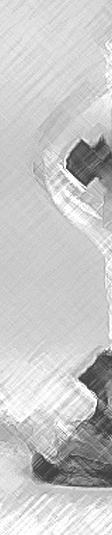

Often called the Crookes radiometer, from the name of the British
chemist and physicist Sir William Crookes (1832-1919) who invented
it in 1875, it is the first vane radiometer used as a detector in the
visible and in the infrared. When exposed to radiations, the rotor revolves
at a speed depending on the intensity and nature of the radiation striking
its vanes; to be more specific, the speed of rotation depends on the heat-producing
effects of the radiation used and decreases from the red to the violet.
Rotation is due to the presence of residual gas in the bulb, which can
be air or another gas at low pressure (about 1 mm of mercury). The molecules
that are near the blackened faces, which heat up by absorbing radiation,
acquire a speed of thermal agitation greater than that of the molecules
that are close to the face that is not blackened; on striking the vanes,
the former transfer an amount of motion greater than the amount transferred
by the latter in the opposite direction and the rotor begins rotating
in the sense that leaves the blackened faces behind.
The name radiometer was given to the apparatus by Crookes who thought
he could use it in measuring the intensity of radiations on the basis
of the speed of rotation which, within certain limits, is proportional
to incident radiation. ...continues