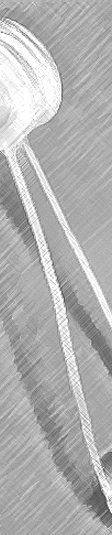

The spring thus formed keeps the tourmaline disks together and, tightly
held between them, the slice of the sample to be analysed, which is usually
held in a cork frame.
The name of the instrument derives from its shape, which is that of tongs.
Tourmaline tongs are the simplest kind of polariscope for observing chromatic
polarization phenomena in crystalline plates both in parallel and convergent
light.
For observation in parallel light, the observer's eye must see the sample
between the tourmaline disks at the distance of distinct vision (about
20 cm) in front of a well-lit background, such as a white wall in full
sunlight.
For observation in convergent light, the observer must see the background
through the tongs held to the eye.
Tourmaline tongs present a coloured field which causes some difficulty
in observation and for this reason they were completely replaced, even
in the field of mineralogy, by the Nicol prism analyser.