

Newton disk
White light, separated into the seven basic colours by means of
a prism, can be recomposed in many ways by superimposing the beams thus
obtained.
It is possible, for example, to use a second prism identical to the first
but upside down, arranged so that its faces and its edge are parallel
to those of the first; or one can use the system of the seven
mirrors illustrated in the following article.
But to generate the sensation of white light in the eye, it is also possible
to use devices which, by exploiting the phenomenon of the persistence
of vision on the retina, allow the superimposition of the physiological
effects of the seven basic colours.
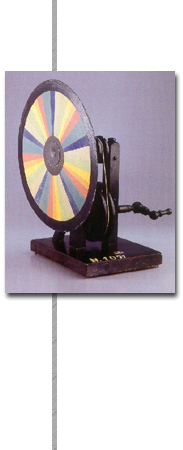
Among these devices there is also the disk that has taken its name from
Isaac Newton (1643-1727) which, in the exemplar conserved in the
museum, consists of a vertical disk of sheet metal that can rotate around
a horizontal axis passing through its centre. ...continues

