
That Davy later observed the arc can be deduced from the description
he gives in the laboratory log of an experiment in 1808; however, it was
only in the volume entitled Elements of Chemical Philosophy, published
in 1812, that he spoke explicitly of the arc, giving a precise, detailed
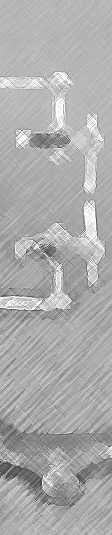
description and drawing of his device with horizontal carbons. In that
experiment Davy used a battery composed of as many as two thousand Volta
piles constructed in the laboratories of the Royal Institution
thanks to funds made available by enthusiasts and patrons of science.
This helps us to understand why it was necessary to await the invention
of high-power sources of electricity, such as the Daniel pile, discovered
in 1836, and the dynamo-electric machines perfected in the second half
of the 19th century, before the technical applications and later developments
and improvements of the arc lamp could become a reality.
In 1849, Jean Bernard Lèon Foucault (1819-1869), invented
a clockwork mechanism for the automatic movement of the carbons, which
led to a widening of the range of application of the arc lamp and its
use in street lighting.