

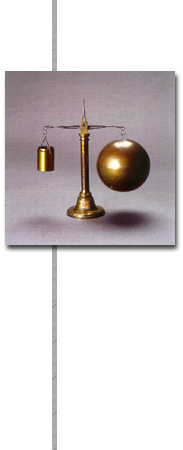
The baroscope is a teaching aid for experimental verification of
the fact that the principle of Archimedes is valid not only for liquids
but also for air and all gases.
It consists of a scale with two arms, the beam of which has hooks instead
of pans; a large hollow brass ball is attached to one arm and a small,
solid brass ball or another counterweight is attached to the other arm
to balance the other.
The baroscope was invented some time around 1650 by Otto von Guericke
(1602-1686), the inventor of the pneumatic machine, who called it
a static barometer. He used it to observe miscellaneousations in atmospheric
pressure by means of the shifts of the needle of a high-precision balance.
In the baroscope conserved in the museum, the beam is made of steel (length
14 cm) and is suspended from a brass column held by a circular base, it
too brass.
The overall height of the instrument is 20.5 cm and the hollow ball, which
is made of brass, has a diameter of 10 cm.

