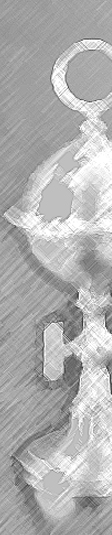

The two hemispheres, having the same diameter and the edges perfectly
smooth, fit each other perfectly and when placed one on top of the other
they form an airtight sphere. A leather gasket with a uniform coat of
grease assured a good seal. The lower hemisphere has a cock and can be
unscrewed from the staff holding it to be screwed to the plate of a pneumatic
machine; the upper one has a ring used to apply traction on it once the
vacuum has been created and the cock closed.
When the two hemispheres contain air they can be separated easily; once
a vacuum has been created and the cock has been closed great strength
is required to pull them apart: the larger the hemispheres the greater
the force needed to separate them. Even when the vacuum is not total the
force applied by each hemisphere on the other is practically equal to
that of atmospheric pressure (equal to 1.03 kg per square centimetre of
the surface delimited by the circular edge of the two hemispheres). In
one of the spectacular public demonstrations performed by von Guericke
at Regensburg (Ratisbon) in 1654, in the presence of Ferdinand III, Emperor
of Germany, he used two hemispheres 44 cm in diameter. Once the vacuum
had been created, only a great effort by eight pairs of horses succeeded
in separating them, with a strong detonation.