


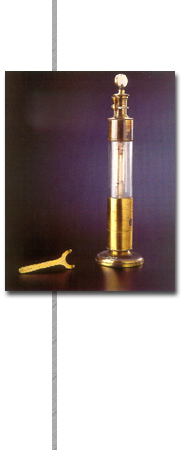
The piezometer is then introduced into the cylinder already filled with
the piezometric liquid and, once closed, filling is completed through
the funnel provided for the purpose.
Initially, the piezometric liquid is at atmospheric pressure and the manometer
is full of air; when compressed, also the air in the manometer is compressed
and the pressure is derived from the decrease in volume.
Three scales are etched on the silver-plated plate: two of them, one for
measuring miscellaneousations in volume of the liquid under examination and the
other for the pressures, are graduated in millimeters; the third, for
measuring temperature, is graduated from 0 to 65° Celsius.
However, it is to be kept in mind that the measurement, as Oersted himself
pointed out, is affected by a systematic error:
The decrease in volume undergone by the tank, which is subject to the
same pressure, both inside and outside, is not taken into account, but
the correction is slight.
A brass wrench is provided with the instrument; on the one hand this allows
it to be opened at the top by unscrewing the brass cylinder with the piston
in order to fill it with piezometric liquid and for introducing the piezometer;
on the other hand, it can be used to unscrew the head of the piston, represented
by a brass plate, for substitution of the leather gasket of the piston.

