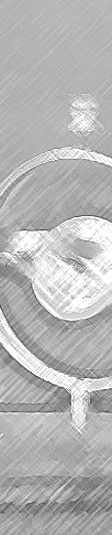

This gyroscope takes its name from the Paris constructor E. Hardy,
who in 1861 had built a model in which a similar gyroscope could be attached
at any point whatever to a graduated, vertical brass ring, with the suspension
axis along an extension of the diameter passing through that point.
In that model, the graduated ring represented a terrestrial meridian and
could be made to rotate, more or less rapidly, around a vertical axis
representing the polar axis.
If the flywheel is made to rotate rapidly with the rotation axis vertical,
a somewhat sharp push making the entire gyroscope rotate around the vertical
axis causes a rotation of the inner ring around its horizontal axis with
the consequent capsizing of the flywheel. From this comes the name of
capsizing gyroscope.
As long as the flywheel rotates uniformly around its axis and the entire
gyroscope rotates uniformly around the vertical axis, the inner ring and
the flywheel rotate together around the horizontal axis.