
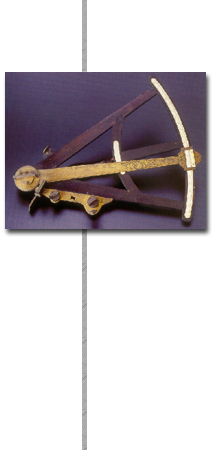
The octant, so-called because its scale is the arc equal to one
eighth of a circle, was invented by John Hadley (1682-1744) who
presented it to the Royal Society in 1751.
It consists of a frame, usually ebony, formed by a one-eighth arc of a
circle and two radial arms. The scale is engraved on the ivory of the
central strip: the scale is divided into ninety parts, each subdivided
into three.
A third arm can rotate around the point of convergence of the other two
and has, at the end that runs on the scale, an index with a vernier which
further subdivides the graduation into twenty parts.
Laterally to the fixed arm on the left there are two small mirrors parallel
to each other and, near these, three pieces of coloured glass having different
tones of colour.
At the other end of the movable arm there is a large mirror placed radially
and on each arm there is a sight composed of a flattened metal pin with
a hole at the top.
The specimen in our collection has a frame in false ebony, the mobile
arm is finely decorated brass and the scale is ivory.
Its range is forty centimetres.

