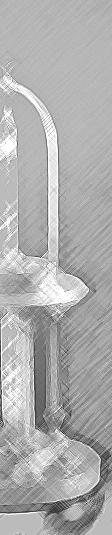

The apparatus, invented by the Paris builders, the Breton Brothers, derives,
with some simplifying changes and improvements, from one built and used
by André Marie Ampère (1775-1836) to verify what
he had deduced theoretically: that a magnetized bar, free to rotate around
its own axis, begins to revolve when it is crossed by a current at a place
not concentric to it. The rotation is caused by the action of the current
on the part of the magnet that it crosses.
On portions of the magnet which are symmetrical to the centre, the action
is contrary; for this reason, in Breton's configuration, in which the
current crosses an entire half of the magnet, the effect is at its maximum.
On inverting the direction of the current, the direction of rotation of
the magnet is also inverted.