
It was the German Thomas Johann Seebeck (1770-1831) who in 1821
showed for the first time that by heating or cooling one of the soldered
joints, the magnetic needle tended to orient itself perpendicularly to
the plate, thus indicating the passage of an electrical current; the direction
of rotation of the needle always indicates that in the copper the current
goes from the warmest to the coolest joint.
He thus demonstrated that by creating a difference in temperature between
the two soldered joints a difference in potential is created between them
(the Seebeck effect).
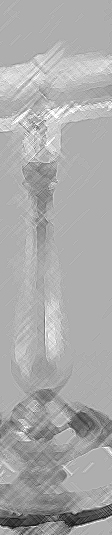
In this model, since the earth's magnetic field tends to make the two
needles rotate in opposite directions and the current makes them rotate
in the same direction, the astatic system, besides eliminating the action
of the earth's magnetic field, also doubles the sensitivity of the instrument.
The one with two needles, designed in 1821, is one of the systems proposed
and used by André Marie Ampère (1775-1836), to eliminate
the disturbing action of the earth's magnetic field in experiments in
which the purpose is to reveal the deviation that a magnetic needle undergoes
through interaction with an electrical current.