

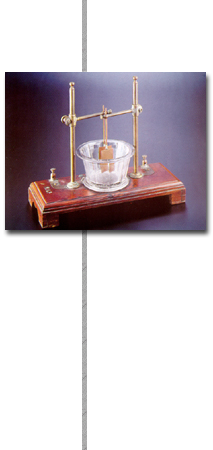
It is a normal electrolytic cell (or voltmeter) consisting
of a glass recipient that is filled with an electrolyte with two metal
electrodes inserted in it, between which a pile having a miscellaneousable resistance
in series maintains a certain difference in potential.
The exemplar exhibited has a rectangular wooden base (30 x 12 cm).
The electrodes are held by two horizontal brass rods attached to two long
vertical supports (height 22 cm, distance 13.5 cm), they too brass, by
means of two bands tightened with a screw; they can therefore undergo
vertical displacements and rotations around their support which allow
regulation of their position so as to place them at the desired distance,
at the centre of the cell, facing each other and parallel to each other.
The base of each support is connected to a wire clamp by means of a strip
of bare copper.
The choice of the electrolytic solution, the electrodes and the shape
of the latter depends on the kind of experiment to be performed; the electrodes
in this model are rectangular and made of copper.

