

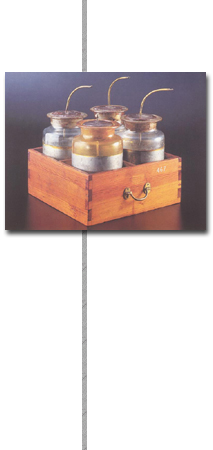
The traditional electrical batteries in use throughout the 19th
century were composed of a system of large bottles, known as Leyden
jars, connected to each other so as to accumulate and then supply
large amounts of electricity.
Their neck is fairly wide so as to allow placing of the internal plate,
a thin reed of tin or other metal, attached to the sides.
They are held in a wooden box the bottom of which is lined with tin foil
and connected to the two metal handles of the box provided to facilitate
carrying.
The metal rods inserted into the bottles through the insulating cap are
all in contact with each other; on the inside they are in contact with
the tin foil lining the inside by means of a tuft of thin reeds or wires.
The battery is charged by connecting one of the poles of an electrostatic
generator to the ends of the rods on the outside and one of the handles
is earthed by means of a metal chain....continues

