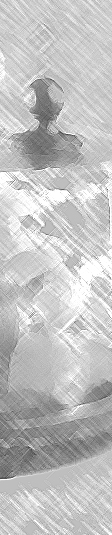

The sample to be examined is introduced and suspended from a non-magnetic
metal rod bent in the form of an L by means of an untwisted thread. The
rod passes lengthwise through a lathed wooden plug lying on the bell and
fitting the circular hole with a certain play.
By moving the rod, which extends through the top of the plug, up and down,
it is possible to regulate the position of the sample with respect to
the poles of the electromagnet from the outside.
The faces of the extensions are straight sections of the soft iron toroidal
nucleus. They are therefore circular and converge towards the centre of
the toroid going from a distance of 1.73 cm to one of 1.46 cm between
them.
The magnetic field between the expansions is thus not uniform and is more
intense where the expansions are closest.
A small sample, either squared or rounded, introduced between the expansions
when the electromagnet is not active, if electricity is applied, will
be attracted towards the region in which the expansions are closest and
the field is strongest if it is paramagnetic and towards the region in
which the expansions are farthest away and the field is weakest if it
is diamagnetic.
...continues