
Many sources of sound emit very weak sounds, thus it is necessary to
amplify them by means of recipients known as resonators having
shapes and sizes such that the mass of air they contain, on vibrating
by influence, reinforce sounds having the same frequency as those emitted
by the source to which they are coupled.
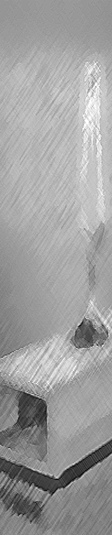
To reinforce the sound of a tuning fork, it is fixed to a box of soft
wood open at one end, the length of which is one quarter of the wavelength
of the sound emitted by that fork in the air. Since they are box-like
in shape, resonators of this kind are called resonance boxes.
With two identical tuning forks mounted on resonance boxes, it is quite
simple and effective to demonstrate resonance phenomena. It is sufficient
to place the two forks with their boxes facing each other, strike one
of them and stop it shortly afterwards. You will then hear the sound coming
from the other, which has "spontaneously" begun vibrating. If
the distance between the two forks is increased, the phenomenon does not
take place, but it is enough to connect the two boxes with an elastic
rod of wood or metal to hear it once again.
It is thus demonstrated that the second fork is excited by the vibrations
of the first one through the resonance boxes.