
By allowing the second fork to oscillate on its own axis,
we see the well-known sinusoidal trend of the beats with a frequency equal
to the difference between the frequencies and amplitudes which miscellaneouss
sinusoidally with a frequency equal to the arithmetic mean of the two
frequencies and therefore not very different from them.
To study the composition of the two orthogonal vibrations optically, one
of the two forks is placed horizontally and the other vertically and a
beam of light is projected onto the mirror of the former so that it is
reflected on the mirror of the latter and from this onto the screen. If
only the first fork is made to vibrate, the dot of light on the screen
describes a horizontal line; if the second fork vibrates the line is vertical.
If both forks vibrate, the dot describes a curve (the Lissajous figure),
the form of which depends on the relationship between the frequencies
of the sounds produced by the two forks and their differences in phase.
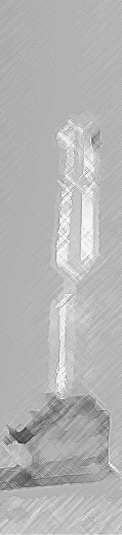
The photographic reproductions show the arrangement of the two tuning
forks for the optical study of the composition of two orthogonal vibrations
and for the graphic study of the composition of two parallel vibrations.
In the latter experiment the two forks are horizontal to the plane of
the vertical prongs; on one of the prongs of the fork on the right a small
plate of glass with the face towards the other fork blackened with lampblack
is fixed vertically; on it lies a horizontal metal point fixed to the
end of one of the prongs of the other fork which moves together with its
support on its horizontal guide, parallel to the direction of the prongs.
The apparatus is in a good state of conservation.