

Lissajous and Desains apparatusfor optical and graphycal experiments on sound

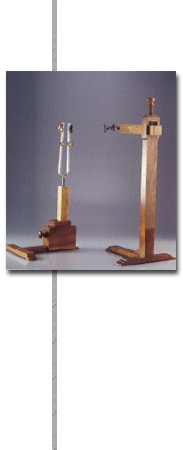
The apparatus is signed by the physicist Karl Rudolph Koenig (1832-1901),
a student of the great Hermann von Helmoltz (1821-1894) at the
University of Könisberg.
It consists of eight steel tuning forks contained in a wooden box (height
11.6 cm, depth 34.5 cm, width 58 cm), three wooden supports and a sturdy
U-shaped horizontal wooden base. Each of the tuning forks is mounted
on a hardwood support of square section and have two brass disks at the
extremities of their prongs, one of which supporting a small mirror and
the other counterbalancing the former to ensure that the tuning fork vibrates
regularly for a long time.
Of the original eight tuning forks, one is missing, three have a fixed
frequency and in the other four the prongs are equipped with cursors which
can be set in different positions, each of which corresponding to a different,
precisely determined frequency. ...continues

